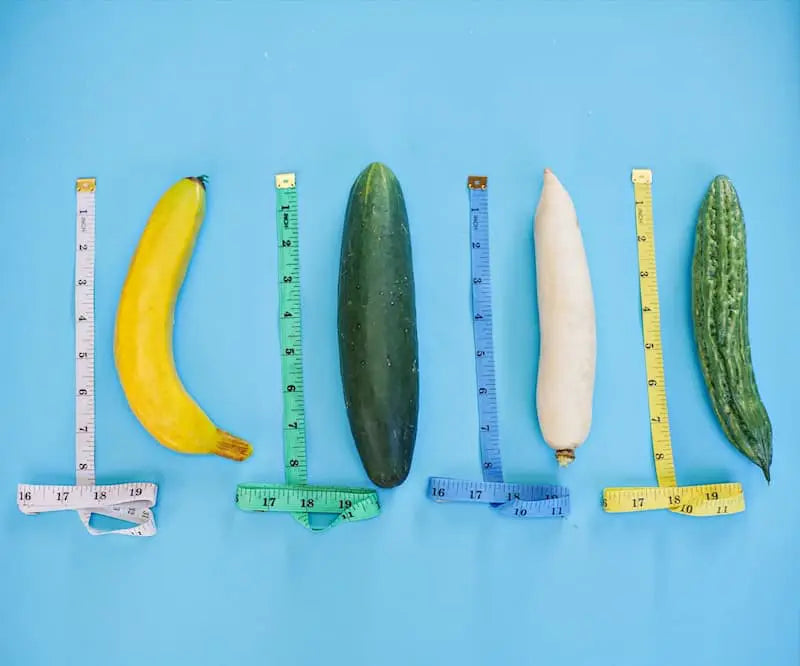
Most guys searching for "average penis size" are really just looking for the answer to one question: "Am I normal?"
The short answer? Yes, you probably are. "Normal" is a massive range, but pop culture has done us dirty by inflating what "average" looks like compared to what actual clinical science says.
If you’re going to compare yourself to the data, you’ve got to make sure you’re measuring the same way the pros do. Here’s the breakdown of what the numbers actually show and how to get an accurate read on yourself.
The Numbers: What is "Average" Anyway?

If you look at large-scale clinical studies (the kind where doctors do the measuring, not just guys filling out surveys), the numbers are usually lower than what you see in movies:
-
Average Erect Length: Usually sits right around 5.1 to 5.5 inches (13–14 cm).
-
Average Erect Girth (Circumference): Usually clocks in at about 4.8 inches (12.2 cm) at the widest point.
The "Self-Reporting" Bias: Many of the 6-inch+ stats you see online come from studies where participants measured themselves. Let’s be real—men tend to be a little "generous" when reporting their own stats. When clinicians take over with standardized tools (and sometimes injections like Prostaglandin or TriMix to ensure a 100% erect state), the average consistently lands closer to that 5-inch mark.
How to Measure Properly (No Cheating!)
If you want to know where you stand, follow the clinical standard:
-
Length: Stand up straight with a full erection. Use a rigid ruler. Press it firmly against your pubic bone (push past any fat pad) and measure to the very tip of the head.
-
Girth (Width): Use a flexible measuring tape or a piece of string. Wrap it around the thickest part of the shaft while erect.
Erect penis length chart
| classification | cm | inches | percentile | vs. average |
|---|---|---|---|---|
| micropenis | <8.1 cm cm | <3.2 inches | <0.02 | >42% shorter |
| very small | 8.1-9.8 cm | 3.2-3.9 inches | 0.02%-0.6% | 42-29% shorter |
| small | 9.8-11.5 cm | 3.9-4.5 inches | 0.6-7% | 29-18% shorter |
| below average | 11.5-13.2 cm | 4.5-5.2 inches | 7-30% | 18-5% shorter |
| average | 13.2-15.0 cm | 5.2-5.9 inches | 30-70% | 5% shorter – 5% longer |
| above average | 15.0-16.7 cm | 5.9-6.6 inches | 70-93% | 5-18% longer |
| big | 16.7-18.4 cm | 6.6-7.3 inches | 93-99.4% | 18-29% longer |
| huge | 18.4-20.2 cm | 7.3-7.9 inches | 99.4-99.98% | 29-42% longer |
| enormous | 20.2-21.9 cm | 7.9-8.6 inches | 99.98-99.999% | 42-56% longer |
| truly massive | >21.9 cm | >8.6 inches | >99.999% | >56% longer |
Erect Girth
But.. let us not forget about girth. If anything, girth is the more impactful of dimensions, versus length. CalcSD's dataset points to the average penis measuring 11.5 cm / 4.5 inches in circumference at its thickest point, which gives us an average range of 10.8-12.1 cm / 4.3-4.8 inches covering the middle 40% of dicks.
Extrapolating out again from that point, we can define the range of girths.
Accurate girth data is especially important for proper condom sizing, as those are sized based on the dick's thickness, not length.
Erect penis girth chart
| classification | cm | inches | percentile | vs. average |
|---|---|---|---|---|
| micropenis | <7.1 cm | <2.8 inches | <0.02% | >37% thinner |
| very small | 7.1-8.3 cm | 2.8-3.3 inches | 0.02-0.6% | 37-26% thinner |
| small | 8.3-9.6 cm | 3.3-3.8 inches | 0.6-6% | 26-16% thinner |
| below average | 9.6-10.8 cm | 3.8-4.3 inches | 6-30% | 16-6% thinner |
| average | 10.8-12.1 cm | 4.3-4.8 inches | 30-70% | 6% thinner – 6% thicker |
| above average | 12.1-13.4 cm | 4.8-5.3 inches | 70-94% | 6-16% thicker |
| big | 13.4-14.6 cm | 5.3-5.8 inches | 94-99.4% | 16-26% thicker |
| huge | 14.6-15.9 cm | 5.8-6.3 inches | 99.4-99.98% | 26-37% thicker |
| enormous | 15.9-17.1 cm | 6.3-6.8 inches | 99.98-99.999% | 37-51% thicker |
| truly massive | >17.1 cm | >6.8 inches | >99.999% | >51% thicker |
Flaccid Size
So now you know how your hard-on fits into the grand scheme of penises, but what about when soft? While flaccid measurements vary all over the place all day long, we still know what our "typical" softie is like. But is it normal? And are you a grower or a shower?
Science has an answer there too: the average flaccid penis measures 9.0 cm / 3.5 inches long. The bell curve on penis size is even narrower on soft measurements, with a central standard deviation covering 60% of flaccid penises for an average range of 3.3-3.8 inches / 8.3-9.7 cm.
Flaccid penis length chart
| classification | cm | inches | percentile | vs. average |
|---|---|---|---|---|
| tiny | <4.1 cm | <1.6 inches | <0.03% | >54% shorter |
| very small | 4.1-5.5 cm | 1.6-2.2 inches | 0.03-0.7% | 54-39% shorter |
| small | 5.5-6.9 cm | 2.2-2.7 inches | 0.7-7% | 39-23% shorter |
| below average | 6.9-8.3 cm | 2.7-3.3 inches | 7-30% | 23-8% shorter |
| average | 8.3-9.7 cm | 3.3-3.8 inches | 30-70% | 8% shorter – 8% longer |
| above average | 9.7-11.1 cm | 3.8-4.4 inches | 70-93% | 8-23% longer |
| big | 11.1-12.5 cm | 4.4-4.9 inches | 93-99.2% | 23-39% longer |
| huge | 12.5-13.9 cm | 4.9-5.5 inches | 99.2-99.97% | 39-54% longer |
| enormous | 13.9-15.3 cm | 5.5-6 inches | 99.97-99.999% | 54-70% longer |
| truly massive | >15.3 cm | >6 inches | >99.999% | >70% longer |
Like soft length, science also has an answer for soft girth. It can be a little squishy to measure, but the same principles apply. With thousands of penis measurements to run numbers off of, we can confidently say that the average soft penis has a girth of 9.0 cm / 3.5 inches. There's typically not a lot of variation in flaccid circumference, so the average range of 8.5-9.4 cm / 3.3-3.7 inches covers the middle 60% of men.
Flaccid penis girth chart
| classification | cm | inches | percentile | vs. average |
|---|---|---|---|---|
| tiny | <5.6 cm | <2.2 inches | <0.02% | >37% thinner |
| very small | 5.6-6.6 cm | 2.2-2.6 inches | 0.02-0.6% | 37-27% thinner |
| small | 6.6-7.5 cm | 2.6-3.0 inches | 0.6-7% | 27-16% thinner |
| below average | 7.5-8.5 cm | 3.0-3.3 inches | 7-30% | 16-5% thinner |
| average | 8.5-9.4 cm | 3.3-3.7 inches | 30-70% | 5% thinner – 5% thicker |
| above average | 9.4-10.4 cm | 3.7-4.1 inches | 70-93% | 5-16% thicker |
| big | 10.34-11.3 cm | 4.1-4.5 inches | 93-99.4% | 16-27% thicker |
| huge | 11.3-12.3 cm | 4.5-4.8 inches | 99.4-99.98% | 27-37% thicker |
| enormous | 12.3-13.2 cm | 4.8-5.2 inches | 99.98-99.999% | 37-48% thicker |
| truly massive | >13.2 cm | >5.2 inches | >99.999% | >48% thicker |
How to measure
Measuring your dick is straightforward, and yet full of complications. In the simplest form, to measure length you should you place a ruler on top of your erect penis, press into the pubic fat until it stops at the bone, and then note the measurement at the end. To measure girth, wrap a soft measuring tape or a strip of paper around the thickest part of your penis.
Compare Your Dick Now!
Why Size Might Change (The "Shrinkage" Factor)
It’s a tough reality to face, but yes—your size can change over time. Typically, the penis reaches its maximum size around age 18 or 19. After that, several factors can cause it to "shrink" in both length and girth:
-
Aging: Natural loss of tissue elasticity.
-
Weight Gain: As the "fat pad" at the base grows, it can conceal the shaft, making it appear significantly shorter than it actually is.
-
Erectile Dysfunction (ED): Lack of consistent blood flow can lead to tissue atrophy.
It’s a tough reality to face, but yes—your size can change over time. Typically, the penis reaches its maximum size around age 18 or 19. After that, several factors can cause it to "shrink" in both length and girth:
-
Aging: Natural loss of tissue elasticity.
-
Weight Gain: As the "fat pad" at the base grows, it can conceal the shaft, making it appear significantly shorter than it actually is.
-
Erectile Dysfunction (ED): Lack of consistent blood flow can lead to tissue atrophy.
What Does Your Partner Actually Want? (Length vs. Girth)

If you’ve ever wondered what’s going through your partner's mind, the truth is that "best" is entirely subjective. However, science has some interesting clues.
A famous study in PLOS ONE used 33 different 3D models and asked 75 women to choose their preference for one-time partners versus long-term partners. The takeaway? They didn't choose the biggest models. They chose sizes that were only slightly above the actual population average.
The Girth vs. Length Debate: When it comes to physical pleasure, girth almost always wins. In a survey by the University of Texas-Pan American, 90% of sexually active women stated that a thicker penis was more important for their satisfaction than a long one.
Why? A thicker circumference provides more direct stimulation to the clitoris and the vaginal walls, where the G-spot and A-spot are located. These sensitive areas don't require deep penetration to be reached.
The Myth of "Deep" Pleasure
One of the biggest misconceptions in sex is that you need a "long sword" to reach the most sensitive spots. In reality, the most reactive zones—including the female G-spot/A-spot and the male P-spot (prostate)—are located only about 5 to 7 cm (roughly 2 to 3 inches) inside. That’s about the depth of your second knuckle.
Because these spots are shallow, the width (girth) of the penis and the angle (positioning) of the act have a far greater impact on pleasure than pure length.
How to Level Up (Without Surgery)
If you feel like you aren't hitting the "average" mark—or you just want to exceed it—you don't necessarily need to go under the knife.

-
Tools for Growth: You can use a combination of penis pumps and rings. Tools like our Voxpump use air pressure to engorge the tissue, creating a temporary but significant expansion. Our kits even come with rings and lube to help maintain that "pumped" state.
-
The Power of Tech: If you're a beginner, a pump with voice control and smart pressure sensors can make the process easy and effective.
Confidence Over Stats
Anxiety about size is usually rooted in cultural stereotypes rather than partner dissatisfaction. Most peopdon't care about a "perfect number"; they care about connection, comfort, and technique.
If you feel like you're coming up short, remember that tools like sleeves, rings, and pumps are there to assist. Sex is an art, and every artist can use a few extra tools in their kit.
Keep an eye out for our next posts, where we’ll be breaking down specific sex positions and "mapping" exactly how to stimulate those G, A, and P-spots for maximum impact.
DIY Penis Strokers: 5 Fruits & Veggies to Try
Curved or Straight? What’s your penis shape?